A First Race Weekend: Follow the Sessions, Not Just the Start
Follow a first race weekend session by session, with concise notes that connect practice and qualifying to the main event and give you clear questions to watch.
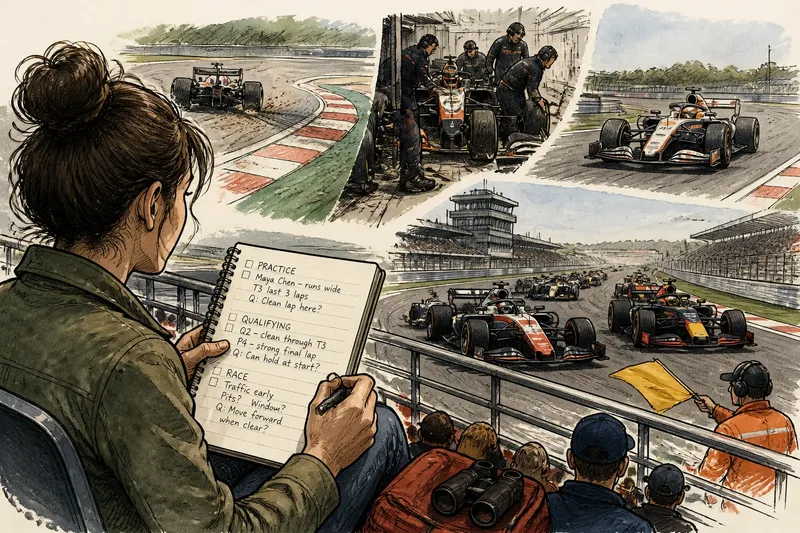
The most common mistake at a first race weekend is arriving for the start and treating everything before it as waiting time. That leaves the race looking like a sudden burst of action rather than the answer to questions raised across the weekend. Following each session gives you a simple way to see what changed, what remains uncertain, and what to watch when the main event begins.
Give each session a job in your notes
A race weekend often includes practice, qualifying, and one or more races, but the order and session names vary by championship. Treat them as separate clues, not repeated chances to watch cars pass: practice helps teams prepare, qualifying sets starting positions, and the race tests those plans under competition.
Bring a small notebook or use a notes app. Write the session name and a few driver or team names at the top, then record brief observations: who looked settled, who had trouble, and what question you want answered next.
This keeps your attention on the story rather than only the timing screen. A lap chart shows who was quickest in a session; by itself, it does not explain why a driver tried a particular line or whether a team was preparing for another part of the weekend.
Practice shows how cars respond to the day
In practice, drivers and teams learn how the car behaves on that circuit in the conditions they have. They may assess braking points, corner balance, tire behavior, traffic, or changes in grip as the track gets used. A driver’s position on the timing board is only one part of the picture.
Watch for visible patterns. A driver who repeatedly runs wide at one corner may be searching for a better approach, while a car returning to the garage may be receiving a setup change or inspection. You do not need to guess the technical cause; note what you can see and check whether it continues later.
Commentary can add context, but keep your own observation simple. If a driver improves after a break, ask whether the car seemed more composed, the track changed, or the driver found clearer space. These are questions rather than conclusions, since practice rarely reveals every team’s race plan.
If there are several practice sessions, compare them instead of treating each as a fresh start. Conditions may shift, and teams may use one session to explore changes and another to refine them. A note such as “more settled through the final sector” gives you something concrete to revisit.
Qualifying turns preparation into a starting order
Qualifying sets the grid, but its format depends on the series. It may use timed segments, a single run, or another arrangement. Check the event schedule or series information for the format and any rules that affect starting positions.
During qualifying, notice how drivers manage their attempts. They may need open track, a clear lap, or a suitable moment to begin a run. A delay can be tactical or caused by traffic; one slow lap does not necessarily mean a driver has lost pace. Watch whether the driver gets a clean opportunity before the session ends.
When qualifying is over, write down the starting positions of a few drivers you plan to follow. Add one visible detail about each result, such as a clean run, a late improvement, a mistake, or an interrupted attempt. This gives the grid context without turning your notes into a full race report.
Starting position matters, but it does not settle the result. The race adds traffic, tire decisions, pit stops in series that use them, and possible interruptions. Treat the grid as the opening arrangement, not the final verdict.
Support races add stories without requiring a second notebook
Many events include support races featuring other championships or classes. Their cars, session formats, and racing styles may differ from those of the headline event. You can enjoy them on their own terms while learning the venue’s routine: where cars queue, how starts are organized, and how officials communicate a delay.
Keep your attention selective. Choose one driver, team, or close contest to follow instead of trying to learn every name on every grid. If the same car appears in several sessions, notice whether its driver changes position or how the team responds after an incident. The aim is familiarity, not memorizing the whole paddock.
Support races also show how different cars use the same circuit. A slower category may approach a corner differently from the main series, and a mixed-class event may require drivers to manage traffic around cars with different speeds. Those contrasts can make the venue easier to read when the headline race arrives.
Turn each session into a race-day question
At the end of a session, write one question that the next session might answer. Keep it specific and observable. “Can this driver complete a clean lap in traffic?” is more useful than “Will the team be good?” because you can watch for the answer without pretending to know what is happening behind the garage doors.
Say you follow an invented driver, Maya Chen, whose car runs wide at the same corner during practice. You note the corner, then watch qualifying: if Chen completes a clean lap there, the earlier problem did not recur on that run. In the race, you can check whether traffic or tire behavior changes what you observe, while leaving the cause open.
Keep your list short enough to use while watching. For each question, note what you can observe and what you will do with either result:
- Check whether the driver who struggled in practice takes a clean line at the same corner; if so, note the change, and if not, keep the corner on your list.
- Check whether front-row starters hold position through the opening corners; if they do, follow the developing lead battle, and if they do not, note which driver gained or lost places.
- Check whether a driver starting farther back moves forward when traffic opens; if so, watch for another clear opportunity, and if not, shift attention to a closer contest.
- Check whether a qualifying lap was interrupted; if it was, compare the driver’s race position with the grid, and if it was not, focus on how the start affects that position.
- Check whether a pit stop changes the order in a series that uses stops; if it does, follow the new pairing, and if it does not, return your attention to track position.
- Check whether an official announcement changes the session or race conditions; if it does, use the revised information, and if it does not, continue following the question already in your notes.
Imagine an invented weekend with these starting inputs: Chen runs wide at Turn Seven in practice, qualifies in the middle of the field after a clean final lap, and starts behind a rival you have also chosen to follow. First, write “Turn Seven: clean line?” beside Chen’s practice note. Next, during qualifying, mark the clean lap as evidence that the earlier issue did not appear on that attempt, without assuming it is solved. Then, in the race, watch Chen through Turn Seven and record whether the line looks clean in traffic. If it does, keep following the battle with the rival; if not, note the repeated observation and leave its cause undecided. The result is a usable account of what changed and what remains uncertain, not a claim about hidden setup choices.
Read the main event as a sequence
The start is dramatic, but the race keeps changing after the field settles. Watch how the order develops, where drivers find room, and whether a lead or close contest remains stable. In a series with pit stops, note when teams bring cars in and how the order changes around those stops. In a race without scheduled stops, focus instead on passing opportunities, defensive driving, and interruptions.
Flags and safety-car periods can alter the contest by slowing or bunching the field. Their effect depends on the rules and circumstances, so use official announcements and commentary to understand what has changed. A restart may create a fresh opportunity, but it does not erase what happened earlier.
Connect what you see to your notes. Did a question from practice return? Did qualifying position matter at the start? Did a support race help you recognize how cars use a particular section? The connection need not be perfect; noticing where the weekend’s clues fit, and where they do not, is part of following the event.
What should you watch besides the leader?
How do you choose a battle to follow?
Choose a contest close enough to follow and watch how it develops over several laps. A driver defending a position, recovering from a poor start, or trying to catch a rival may offer a clearer story than a leader running alone.
Do practice times predict the race?
Practice times show how cars performed in that session, not a complete forecast of race day. Track conditions, traffic, setup choices, qualifying, and race strategy can all change the picture.
What should you do if the format is unfamiliar?
Check the published schedule and the series’ explanation of its qualifying and race rules. Then follow the session in front of you: note its purpose, the order it produces, and what information remains unresolved.
How can you follow several drivers without losing track?
Pick a small group with different starting positions or different stories, and write down only what you want to check in the next session. Add another driver when a clear event gives you a reason to follow them.
Check event details before making assumptions
Schedules and rules differ across championships, and even a familiar event can change its running order. The event program, official timing, and series announcements are useful places to confirm session names, start times, qualifying rules, and changes; at the venue, follow the organizer’s instructions.
You do not need every technical term to follow a race weekend. Start with the purpose of each session, keep a few observations, and bring unanswered questions to the next one. A short note can work like a list on the fridge: only the items you need to remember, arranged so you can check them quickly. Search for a first race weekend session guide when you want a simple way to connect those notes; by the main event, the start becomes one part of a story that began earlier.