Why a Circuit Needs More Than a Long Straight
Circuit layout is more than straight-line speed: learn how corner sequences shape braking, grip, rhythm, overtaking chances, and the demands on a driver.
The most common mistake in judging a circuit is to treat its longest straight as the main event. That shortcut misses what happens before and after it: circuit layout determines how a car arrives at the straight, what the driver must do to get there, and whether the next corner rewards speed or precision.
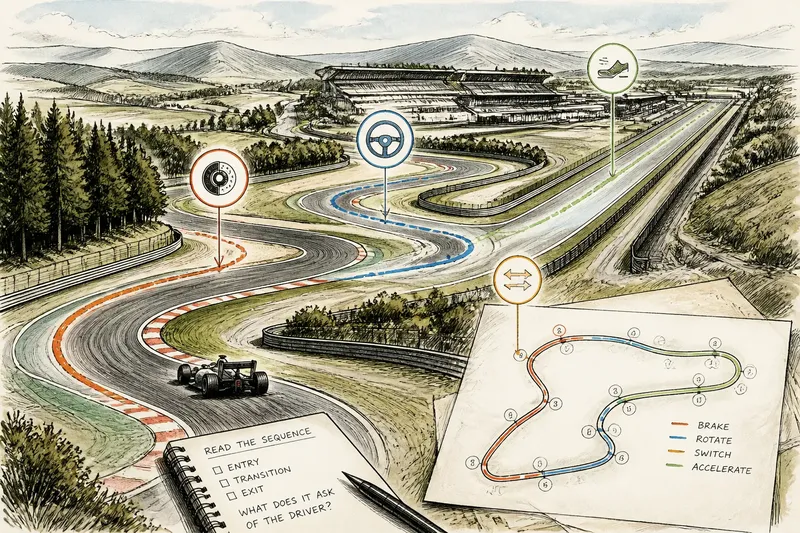
To read a track well, follow its corners in sequence rather than ranking them one by one. A bend is not an isolated obstacle; it changes the car’s speed, balance, and position for the turns that follow. Start at the circuit map, trace the route in order, and ask what each section makes a driver carry forward.
Begin with the corner sequence, not the longest straight
On a circuit map, mark each turn and note whether it bends left or right, opens or tightens, and leads into another corner or a straight. Those relationships tell a more useful story than a list of turn names. A long straight after a slow corner asks a different question from one after a fast, flowing bend.
Think of the layout like a chain of differently shaped links: pulling on one link affects the next. A tight corner may demand heavy braking and a slow exit, while the following bend asks the car to change direction quickly. The driver cannot reset between them; the first corner sets up the second.
For each sequence, identify three things:
- Entry: What speed and direction does the car bring into the first corner?
- Transition: Does the next turn require another braking zone, a quick change of direction, or a steady arc?
- Exit: Where does the car need to be positioned for the straight or the next sequence?
This simple trace reveals whether a section rewards a single decisive turn or a connected set of choices.
Sort corners by the challenge they create
Corner shape matters, but the job a corner performs matters more. A slow hairpin tests braking and traction on exit. A long, constant-radius turn asks the car to hold a line while its tires sustain lateral load. A quick left-right combination tests how cleanly the car changes direction without losing balance.
These demands can overlap. A corner may begin as a braking problem and become an exit problem, especially when the driver must turn while still managing deceleration. A sequence of bends can also make tire grip feel different from one moment to the next: the car may arrive with its weight shifted from the previous direction change.
When tracing a map, write a short verb beside each corner: brake, rotate, hold, switch, or accelerate. The words are not a technical rating; they are a way to see whether the circuit repeats one kind of task or keeps asking for another. A layout dominated by repeated hairpins has a different rhythm from one that alternates between sweeping bends and tight exits.
Read braking zones and exits as connected tasks
A braking zone is shaped by what comes before it. A straight gives the car room to build speed, but the driver must then slow and place it for the corner. If the braking point is followed by a turn that tightens, the ideal line may require patience: turning in too early can leave the car poorly positioned for the later part of the bend.
Exits matter just as much. A corner that feeds onto a long straight places a premium on getting the car pointed in the right direction and applying power without asking the tires to do too much at once. A corner that leads directly into another bend may reward a line that sacrifices a little exit speed to improve the next entry.
Imagine a fictional circuit with a long straight ending in a tight right turn, followed immediately by a left-hand bend. A driver who focuses only on braking for the right turn may turn in early and arrive at the left bend on the wrong side of the track. If the driver instead leaves room for the second turn, the expected observable result is a cleaner route through the pair, even if the first corner looks less direct.
Check what the sequence asks of the driver
A useful circuit read considers how often the driver must change tasks. A track with long intervals between corners may allow time to prepare for each major braking zone. A compact sequence can demand repeated adjustments: brake, turn, unwind the steering, then change direction again before the car has fully settled.
Look for places where a mistake can carry forward. Running wide at one corner may compromise the approach to the next; a poor exit can leave the car vulnerable on the following straight. This connection is part of the circuit’s challenge, not an incidental detail. It also explains why two corners that look modest on a map can become demanding when linked together.
Do not infer difficulty from the number of turns alone. A map can show many bends, but their spacing, direction, and speed determine how they combine. A sequence of gentle curves may ask for steady commitment, while a shorter group of sharp changes may demand frequent corrections and careful placement.
Judge the straight by what it connects
A straight is still important. It gives the car time to accelerate, creates a clear approach to a braking zone, and can provide an overtaking opportunity. But its sporting effect depends on the corners at both ends. The entry corner influences speed onto it; the next corner determines how drivers must position themselves at its end.
Compare two straights on the same map by asking what feeds into them and what follows. One might begin after a slow turn, where a clean exit matters. Another might follow a fast bend that limits how much speed the car can carry. Their lengths alone do not tell you which section will shape the race more strongly.
Also consider whether the straight offers a useful approach for a pass. A following corner with several plausible lines may create room for a driver to challenge. A narrow entry or a sequence that immediately punishes a compromised line may make the same approach harder to convert into a lasting position. The map suggests these possibilities, though the cars and event conditions affect how they play out.
What should you look for on a circuit map?
How can I tell whether a corner is slow or fast?
A map alone gives only a clue: tight turns and sharp changes of direction often suggest lower-speed work, while broad arcs suggest faster cornering. Track width, banking, surface, and the cars using the circuit also affect the speed a corner can support.
Why do two corners in a sequence need to be judged together?
The first corner determines the car’s position and balance for the next one. A line that looks best through the first bend may leave little room to turn, accelerate, or defend through the second.
Does a longer straight always create better overtaking?
No. The corner before it affects how much speed a car can carry onto the straight, while the next corner affects whether a driver can use an advantage to attempt a pass. The surrounding layout matters alongside the straight itself.
What makes a circuit feel flowing rather than stop-start?
Flow often comes from corners that connect in a way that lets a driver carry direction and momentum through successive turns. Repeated sharp braking zones and short transitions can instead make the lap feel more interrupted.
Build a complete reading of the layout
For a final pass, trace the map from start to finish and describe each section in one sentence: what the driver must do, what the section leads into, and what a mistake would affect next. Then review the longest straight in that context. If its approach and exit tell you more than its apparent length, you are reading the circuit rather than admiring a line on paper.
This method keeps circuit layout grounded in observable demands: braking, direction changes, sustained cornering, and the placement needed for what comes next. A long straight can define a feature of a lap, but the corner sequence gives that feature its meaning.