The Fastest Lap Does Not Tell the Whole Race
Fastest lap is a striking number, but reading lap-to-lap consistency reveals how pace, traffic, tire care, and mistakes shape a driver’s race.
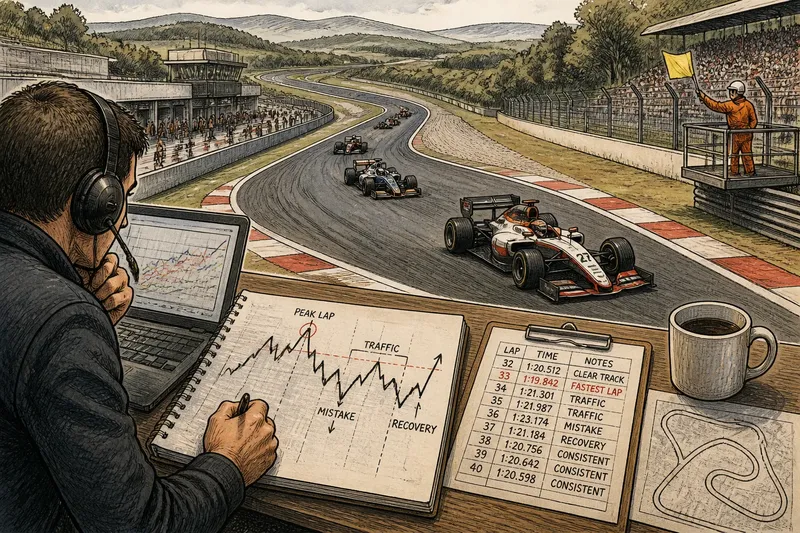
The common mistake in reading fastest lap is treating one clean, brilliant tour as a summary of the whole race. That number can hide laps lost in traffic, a mistake that required recovery, or a car whose pace faded as its tires changed. To understand race performance, compare the fastest lap with the pattern of laps around it.
Consistency does not mean every lap is identical. Drivers encounter changing traffic, flags, tire condition, and tactical demands. The useful question is whether the driver kept producing competitive laps while responding to those conditions.
1. Treat the fastest lap as a peak, not a verdict
A fastest lap records the best completed tour under the circumstances of that race. It tells you that the driver and car reached a particular level of pace at least once; it does not tell you how often they approached it, or what was happening elsewhere in the field.
That peak may come when a driver has clear track, a favorable tire condition, and room to push. Another competitor might be faster across most of the race but never get the same clean opportunity. The single number is still useful, but it describes a moment rather than a complete performance.
Think of a fastest lap as a sharp pencil mark on a long page of notes. It draws the eye, while the surrounding entries explain what happened. Start by locating the lap in the race and asking what conditions made it possible.
2. Compare the lap with its neighbors
A lap does not happen in isolation. Look at the laps immediately before and after the fastest one. If they are also strong, the driver may have been operating at a sustained pace; if they are noticeably slower, the best lap may reflect a brief opening or a particular push.
Nearby laps also help reveal whether the driver had to pay for that peak. A forceful lap followed by a slower one could reflect traffic, a tire-management choice, a mistake, or an ordinary change in conditions. Timing alone may not identify the cause, so avoid turning a pattern into a claim about intent.
Imagine a fictional race in which Driver A sets a striking best lap after emerging into clear track, then posts several slower laps while closing on a group of cars. Driver B never matches that peak but records a close cluster of competitive laps. The reasonable reading is that A had the sharper peak while B showed a steadier sequence; without more context, neither description alone settles who drove the better race.
3. Read the spread across a stint
A stint is the portion of a race a driver completes on a set of tires, ending at a pit stop or the finish. Compare the laps within that stretch rather than selecting only its quickest entry. A narrow spread can suggest that pace held up; a widening spread may point to changing tire condition, traffic, or a shift in how the car could be driven.
For a fair comparison, use laps from comparable parts of each driver's stint. The opening laps after a pit stop may differ from the later laps, and a driver who starts among other cars may have little chance to match someone running alone. A raw average can blur these differences, so check the lap sequence as well as any summary number.
Consistency is not simply a low spread at any cost. A driver circulating steadily but well off the pace is not necessarily outperforming one who mixes fast laps with a few slower responses to race conditions. Read steadiness alongside the level of pace and the work the driver was doing.
4. Separate traffic effects from driving pace
Traffic can make a capable driver look inconsistent. A car following another may lose time through compromised cornering lines, while an overtake can create a slower lap even when the pass is necessary. Conversely, clear track can let a driver string together laps without interruption.
Check whether slower laps coincide with visible traffic, a pass, or a period when the driver was defending. If timing data includes sector splits, compare where the loss occurred: a delay concentrated in one sector may fit a local obstruction, while a broader change may have another explanation. Onboard footage and race timing can add context, but neither should be treated as a complete account by itself.
Do not automatically excuse every slow lap as traffic or label every quick one as proof of superior pace. Use the available evidence to distinguish an observed pattern from a possible explanation. That distinction makes a race reading more careful and more useful.
5. Notice the cost of mistakes and recoveries
A lock-up, missed apex, or poor exit can damage a lap and affect the next one. The first loss is visible on the timing sheet; the consequences may continue as the driver regains position, manages the tires, or approaches another corner out of rhythm. A single lap value cannot show that chain clearly.
Look for an unusually slow lap followed by a return toward the driver's prior pace. That sequence could fit a mistake and recovery, but it could also reflect a yellow flag, traffic, or another event. If video or timing notes clarify what happened, use them; if not, describe the anomaly without asserting its cause.
Recovery itself is part of racecraft. A driver may respond to a small error by settling back into a repeatable rhythm rather than trying to win the lost time immediately. The result can be less dramatic than a personal-best lap, yet more valuable over the remaining distance.
6. Compare drivers only in a fair context
Lap times are shaped by more than the person at the wheel. Cars can differ in setup, tire condition, fuel load, and how they respond to a particular circuit. Race position also matters: one driver may be pushing to catch a rival while another is protecting a lead or preserving room for a later move.
When comparing teammates, note whether their laps came under similar conditions. Matching stints, comparable traffic, and the same phase of the race make a more meaningful comparison than placing two best laps side by side. Even then, the comparison can describe what happened without proving why the gap appeared.
These limits do not make lap data useless. They tell you to make narrower claims. “This driver sustained a similar pace through the clear-track portion” is more defensible than “this driver was faster all day” when the evidence covers only part of the race.
7. Ask what the race demanded at that moment
Drivers do not always aim to produce the quickest possible lap. They may need to hold position, leave room for a pass, avoid a rival's mistake, or keep the car controlled while conditions change. A slower lap can be a sensible response to the race rather than a failure to perform.
That does not mean every dip is strategic. It means that a useful interpretation connects pace with the situation: where the driver was on track, who was nearby, and whether the lap belonged to a push, defense, or recovery. Use only context that can be observed, and leave motives uncertain when the evidence does not reveal them.
What should you check before judging a lap?
Does the fastest lap sit among other quick laps?
Compare it with the laps immediately before and after. A cluster suggests more sustained pace than an isolated peak, though traffic and changing conditions still matter.
Was the driver in clear air or caught in traffic?
Check race position, nearby cars, and any available footage. A lap in clean air and one spent following closely are not directly equivalent.
Did pace change across the stint?
Look at the sequence from comparable parts of the run, not only its quickest and slowest laps. A developing pattern can help distinguish a brief interruption from a broader change.
What can the available evidence actually support?
Separate the lap-time pattern from your explanation for it. If the cause is unclear, state what the timing shows and leave the cause open.
Use consistency to ask a better race question
The fastest lap remains a useful sign of peak pace, but it cannot stand in for the entire race. Read it beside neighboring laps, stint patterns, traffic, and the demands of each moment. This turns “Who set the quickest lap?” into a more revealing question: “Who kept producing useful pace, and under what conditions?”
When you read a timing sheet, start with the sequence rather than the standout number. Fastest lap can tell you where a driver reached; consistency helps explain how much of the race they spent near that level, and what the race asked of them along the way.