How the Rear Wing Became a Fixture on Racing Cars
Rear wing racing-car history traces the move from experimental add-on to standard design feature, showing why teams use wings to shape grip and balance.
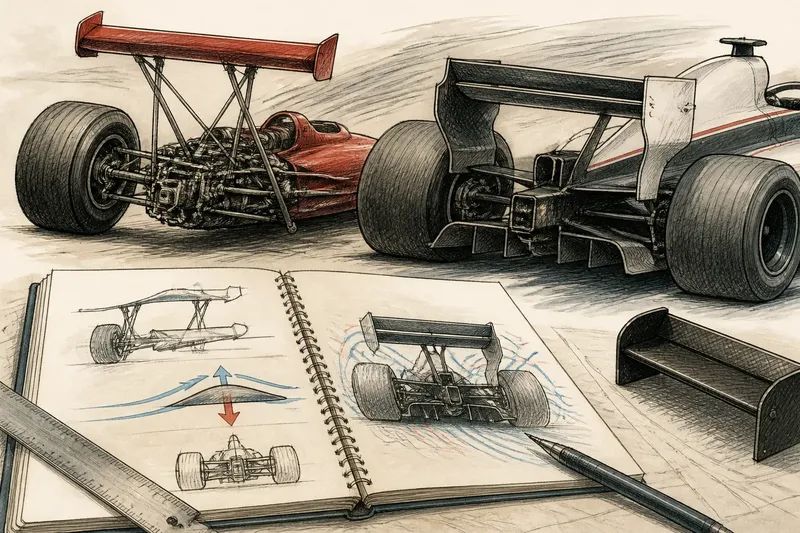
The common mistake in rear wing racing-car history is to imagine that wings arrived as a finished, dependable part of the racing car. Their rise was uneven: engineers tried exposed aerofoils, racing authorities responded to dangerous installations, and designers gradually brought wings closer to the body.
Early racing cars relied on tires and body shape
For much of motor racing’s early decades, designers pursued grip through tires, suspension, and weight distribution. Car bodies were shaped mainly to house mechanical parts and manage drag; they were not generally designed as major sources of aerodynamic downforce.
By the 1960s, rising speeds made aerodynamic lift a practical concern. At the 1968 Belgian Grand Prix, Ferrari and Lotus appeared with high-mounted wings on their Formula One cars. These striking devices used airflow to press the car toward the track, but their height and exposed supports raised questions about how the loads were carried.
High-mounted wings made the idea visible and raised safety concerns
Those early installations were not simply small refinements to bodywork. A high wing could sit in relatively clean airflow and act as a distinct aerodynamic surface, but its supports had to transmit substantial force into the chassis. Failures during the 1969 Spanish Grand Prix weekend brought the risks into sharp view.
Formula One authorities restricted high-mounted wings during that period and later rules pushed designs toward lower, more securely supported structures. The change did not end the use of wings. It encouraged engineers to fit them within more controlled limits and to treat mounting, position, and body integration as part of the design rather than as afterthoughts.
Lower wings became part of a more integrated car
As regulations constrained height and placement, rear wings settled into a lower, more familiar position at the back of the car. Designers continued to adjust the wing’s profile and angle, while shaping the surrounding bodywork to guide airflow toward and around it. The wing became one element in a larger aerodynamic package.
This development did not follow one universal timeline across every racing category. Rules differ, and so do the demands of open-wheel cars, sports cars, and other machines. Still, the broad shift is clear: an exposed experiment became a more controlled component, designed to work with the car rather than merely sit above it.
Bodywork and a separate wing solve related problems differently
A body-led approach uses the car’s surfaces and underside to influence airflow. It can avoid a tall external structure, but a change to the shape may also affect cooling, drag, or airflow elsewhere. A separate rear wing offers a more distinct surface for creating rear load, while adding drag and forces that its mounts must carry.
Many racing cars combine both approaches. The body directs air, and the wing works within that flow. Like a doorstop and a door’s shape working together, the parts have different jobs but affect the same movement; changing one can alter what the other needs to do.
Say a fictional team has a car whose rear feels secure in slow corners but becomes less settled as speed rises. The team’s starting point is that observed change, not a claim that the wing is too small. Engineers could first review the rear-wing setting and the bodywork’s airflow path, then make one controlled adjustment and compare the car’s response over the same type of corner. If the rear becomes more consistent but the car loses too much speed on straights, the tradeoff points toward revisiting the setting or the wider aerodynamic balance rather than simply adding more wing.
Which rear-wing questions matter to car design?
Why did racing cars begin using rear wings?
As speed made aerodynamic lift more consequential, a wing offered a way to create downward force near the rear tires. That force can help the tires maintain grip, although the wing also creates drag.
How does a rear wing create downforce?
An inverted aerofoil redirects airflow so that it produces downward force on the car. The resulting load depends on the wing’s shape and position as well as the airflow around the rest of the vehicle.
Why not shape the body instead of adding a wing?
Body shaping can influence airflow without a prominent external component, but its effects may reach several areas of the car at once. A separate wing makes the aerodynamic surface distinct, while adding its own drag and mounting demands.
Why are rear wings still part of racing-car design?
A rear wing provides a visible way to manage airflow and add load near the rear tires. Its shape and placement have changed under different rules, but the basic purpose remains recognizable.
Rear-wing racing-car history shows how rules shaped the design
Rear-wing racing-car history is not a simple contest between integrated bodywork and a separate aerofoil. High-mounted wings made downforce conspicuous, safety concerns and regulations constrained their installation, and later designs combined lower wings with carefully shaped bodies.
When comparing racing cars, look at where the wing sits, how its supports meet the car, and how the bodywork guides air toward it. Those visible details help explain how designers seek rear-tire load while managing drag and keeping the aerodynamic forces within the car’s overall balance.