Sprint Race vs Endurance Race: What Changes for a Driver?
Sprint race vs endurance race: learn how drivers adapt their pace, tire use, passing choices, and focus to the demands of each format.
The common mistake in a sprint race vs endurance race comparison is to call the sprint a pure speed test and the longer event a test of patience. That shortcut can cost a driver options: a sprint still rewards judgment, while excessive caution in an endurance race can surrender time that may be hard to recover. The central difference is how long the driver must preserve the ability to make clear decisions.
Imagine Mara, a fictional driver entered in a sprint and an endurance event at the same circuit, in the same car, from the same grid position. In each race, a rival is ahead. The comparison shows how the time available can change a sound decision; it does not claim that one format measures more skill than the other.
A sprint race makes each opening decision expensive
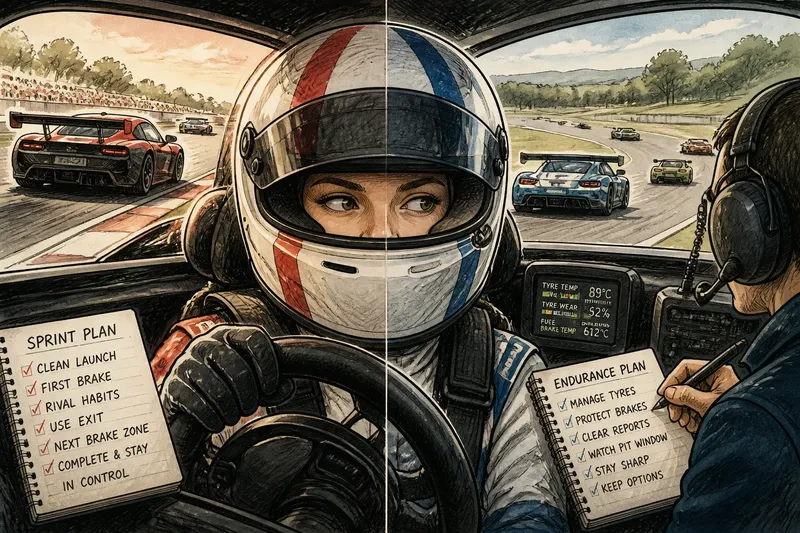
In a sprint, Mara has limited time to recover from a slow start or a missed passing opportunity. She focuses on a clean launch, a safe line into the first braking zone, and reading the rival’s defensive habits. Immediate pace matters because a delay can leave her behind traffic for much of the event.
Urgency does not mean attacking every corner. A lunge from too far back can spoil the exit, leave the car vulnerable on the next straight, or cause contact. The useful question is not merely, “Can I pass here?” but, “Can I complete the move and stay in control through the next sequence?”
Say Mara sees the rival defend the inside at a tight corner, leaving the outside open but dirty. She stays close rather than forcing a doubtful pass, then uses a better exit to try a move at the next braking zone. She expects to draw alongside more cleanly, though a position gain is uncertain. Waiting one corner is still an active choice if it improves the shape of the attack.
With less time to settle into a rhythm, Mara also needs to spot problems quickly. If the car slides more than expected, she can adjust her braking reference or soften her steering input instead of repeating the same mistake. Event rules still govern tire and fuel use; her immediate task is to preserve enough grip and concentration to race effectively.
An endurance race makes pace a resource
In an endurance race, Mara must make quick laps part of a sustainable pattern. Close battles can add strain through tire wear, brake heat, fuel use, and mental fatigue. Managing effort means choosing where to spend attention and car performance, not driving slowly by default.
She watches for changes in the car’s response. A sliding exit may suggest that her inputs are asking too much of the tires, while a longer pedal or altered brake feel calls for prompt communication with the team. The team can interpret her report and consider a change in pace, setup, or pit timing. A useful report names the sensation and when it occurs.
Imagine Mara is following a rival who is difficult to pass. She avoids forcing a move on every lap, tries to limit tire sliding, and asks the team to watch for a suitable pit-window opportunity. She expects to reach the next strategic decision with the car and her attention still usable. If the rival makes a mistake or traffic changes, she retains more than one option.
This does not mean coasting while others pull away. Protecting the car too aggressively can cost time that may not be recovered. A clean, committed pass may justify its demands; a low-odds attempt that risks damage may not.
Sprint race vs endurance race decisions depend on the situation
Does a sprint race require less tire management?
Not necessarily. A shorter race may leave less time for wear to accumulate, but tire condition can still affect grip, overtaking, and the finish. Follow the event’s tire rules and respond to the car rather than assuming the tires can be ignored.
Why does traffic matter in endurance racing?
An endurance event may bring together cars with different speeds, strategies, or class duties, requiring drivers to pass or yield while staying focused. Reading another driver’s line early can help avoid abrupt moves. Traffic is part of the pace calculation, not merely an interruption.
Is the fastest possible lap always the right target?
A fast lap is useful when it advances the race without creating a greater cost. A sprint pass may justify a brief push, while repeated maximum effort in an endurance race can strain the car or driver. The right pace depends on position, remaining distance, traffic, and the team’s plan.
How does a driver know when to push?
Mara weighs the chance of gaining a position against the possible costs of tire wear, contact, lost time, or a mistake. She also considers whether the rival is vulnerable now or a later opportunity looks better. The decision changes with the race; it is not a fixed rule tied only to format.
The same driving skill takes different forms
In the sprint, Mara needs to make each opening count and keep her attacks precise. In the endurance race, she needs to preserve her decision-making capacity while staying quick enough to contest position. A decisive move can shape a sprint; adaptable choices can keep an endurance driver in contention.
Endurance is not simply physical stamina. It also involves maintaining attention, describing the car’s behavior clearly, and avoiding both needless aggression and needless caution. Sprint craft is more than raw speed: it includes recognizing when a brief opportunity is worth taking.
That is the useful distinction in a sprint race vs endurance race: the format changes the time horizon of each decision, not the value of judgment itself. Before either event, a driver can review the rules, agree on clear communication with the team, and treat pace as something to apply with purpose. A simple analogy is a dimmer switch: the driver adjusts effort to the situation rather than leaving it fixed at full brightness.